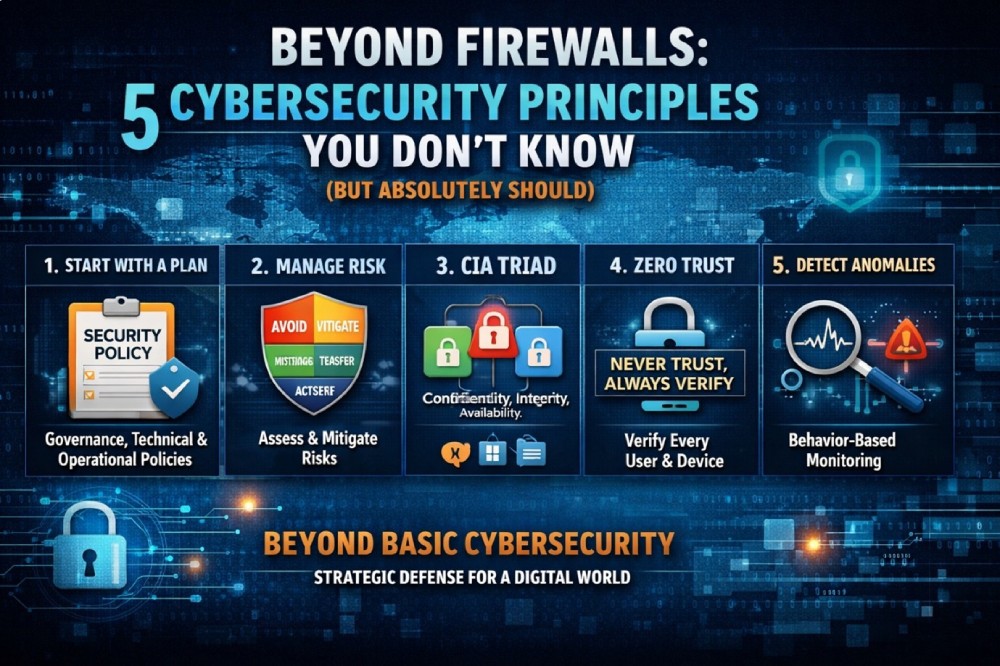
Beyond Firewalls: 5 Cybersecurity Principles You Don’t Know (But Absolutely Should)
Deputy Head of Master IT Program
Head of Cybersecurity Research Centre of Excellence
Head of Security Operations Center
Swiss German University
When most people think about cybersecurity, their minds jump to the familiar: antivirus software, complex passwords, and news headlines about the latest data breach. These are the visible artifacts of defense—the locks and alarms in a digital context. However, textbook cybersecurity treats these as low-level tactics; the real strength of modern cyber defense lies in strategic principles that govern the design, implementation, and management of security programs at scale. These principles are rooted in governance, risk management, system design, and emerging threats. This post explains five foundational principles that organizations must master to meaningfully secure their information assets.
- It All Starts with a Plan, Not a Product
Effective cybersecurity begins with policy, not products. In information security management literature, a formal Information Security Policy (ISP) is the strategic blueprint that defines what must be protected, who is responsible, and how protections are implemented across people, processes, and technology [1]. Security policy provides direction and constraints for every security control, from firewalls to authentication systems.
Textbooks in information security emphasize that security is a management problem, not merely a technological one, and policies must align with business objectives and compliance requirements [1]. Well-crafted security programs usually consist of:
-
- Governance policies: High-level commitments covering acceptable use, confidentiality expectations, and strategic goals.
- Technical policies: Enforced configurations such as encryption standards, password lifecycles, and access control rules.
- Operational policies: Day-to-day procedures such as backup schedules, patch management, and incident response protocols.
Without policy, tools have no context; a firewall without rule sets is just hardware.
- You Can’t Eliminate Risk, So You Must Manage It
Rather than pursuing the impossible goal of “zero risk,” information security textbooks teach that risk must be identified, assessed, and managed to levels acceptable to the business [2], [3]. Risk management is integral to modern security frameworks such as ISO/IEC 27000 and NIST CSF, which position risk treatment (avoid, transfer, mitigate, accept) as central to security planning [3], [4].
Risk is defined as a function of threats exploiting vulnerabilities to impact assets. Controlled investments are applied where they yield the greatest risk reduction relative to cost [3]. A sophisticated cybersecurity program documents risks, owners, likelihood, impact, and chosen treatment strategies—allowing informed resource allocation rather than ad-hoc tool purchases.
- Every Security Action Serves Three Core Goals
At the core of security engineering is the CIA Triad: Confidentiality, Integrity, and Availability [5]. This framework provides the “why” behind controls:
-
- Confidentiality: Ensures information is accessed only by authorized subjects.
- Integrity: Guarantees information has not been tampered with.
- Availability: Ensures systems and data are accessible when required.
The CIA triad is foundational in security textbooks and standards alike, guiding the classification of controls and controls’ objectives. Whether configuring access control lists (confidentiality), hashing logs (integrity), or architecting backups and redundancy (availability), every control aligns to one or more of these objectives.
Some extended models (e.g., Parkerian Hexad) propose additional dimensions, but CIA remains the de facto baseline in most enterprise frameworks [5].
- The New Commandment Is “Trust No One”
Traditional perimeter-centric security models assumed that once inside the network boundary, users could be implicitly trusted. Modern practice rejects this assumption. The Zero Trust Security Model is now widely acknowledged as the appropriate paradigm for cloud and hybrid environments [6], [7].
Zero Trust operates on core tenets:
-
- Never trust, always verify: Every access request from any user or device must be authenticated and authorized.
- Least privilege: Grants only the minimum permissions necessary.
- Micro-segmentation: Divides networks into isolated segments to limit lateral movement.
In contrast to castle-and-moat models, a Zero Trust architecture treats every user and device as potentially hostile until proven otherwise, drastically reducing the blast radius of compromised credentials or insider threats [6], [7].
- Modern Defense Is About Spotting Weird Behavior, Not Just Known Villains
Legacy protection mechanisms such as signature-based antivirus and static firewalls detect only known threats. Today’s threat landscape demands proactive detection of unknown threats through behavior-based anomaly detection.
Recent research and industry practice emphasize using machine learning (ML) and artificial intelligence (AI) to model normal system and user behavior and then identify deviations indicative of compromise or exfiltration [8], [9]. Techniques such as unsupervised learning, autoencoders, and isolation forests are applied to network logs, endpoint telemetry, and user behavior analytics to identify subtle, emergent threats that signature systems miss [8], [9].
This approach aligns with Zero Trust’s continuous verification philosophy by focusing on dynamic indicators rather than static lists of known bad actors.
Conclusion: From Technical Problem to Strategic Mindset
Cybersecurity has evolved from simple perimeter defenses to a strategic discipline encompassing governance, risk management, architectural principles, human factors, and advanced detection techniques. Understanding and applying these five principles—policy governance, risk management, CIA objectives, Zero Trust, and intelligent anomaly detection—transforms security from a set of tools into a resilient posture aligned with business objectives.
Now that you see security as a strategy, which of these principles is your own digital life—or your business—missing most?
References
[1] M. E. Whitman and H. J. Mattord, Principles of Information Security, 7th ed. Cengage, 2021.
[2] Fundamentals of Information Systems Security, Jones & Bartlett Learning, 2023.
[3] ISO/IEC 27000 Family of Standards, ISO/IEC, 2023.
[4] NIST Cybersecurity Framework, National Institute of Standards and Technology, 2018.
[5] “Information security principles: Confidentiality, integrity and availability,” Cybersecurity Fundamentals, Reeves & LaVallee, 2025.
[6] A. Tilmar Jakobsen, Zero Trust Security. Wiley, 2025.
[7] “Zero Trust Cybersecurity Framework,” Encyclopedia, vol. 4, no. 4, pp. 1520–1533, 2024.
[8] S. A. Okolie et al., “Anomaly detection in heterogeneous cybersecurity data,” FRAOPe, 2025.
[9] M. Eunice, Machine Learning Models for Anomaly Detection in Zero Trust Architectures, Federal University Research, Apr. 2025.